
Estimated reading time: 6 minutes
Businesses use organizational structures to show a picture of the chain of command and to help employees understand reporting relationships.
The management structure of a small business will determine its ability to flow work throughout the organization.
Whether you manage a large or small business, every organization should manage with a defined organizational structure.
A well-thought-out and strategic business configuration clarifies reporting relationships and supports effective internal communication.
This detailed planning can result in an efficient and effective work process flow and can foster team development.
Who Should Define An Organizational Structure?
The board and senior leadership should be the group that determines the type of organizational structure most appropriate for the business.
The goal is to identify a structure that would best support the internal operations, how work is carried out, and the chain of command.
Determine the best structure for your business by answering these questions:
- What are the functional groupings of work processes? For instance, most organizations have an accounting, human resources, and purchasing function. Often it makes sense to organize by these areas of expertise.
- Are there natural groupings of teams, work groups, or units? For instance, let’s say you run a recording studio. There will be a team of producers, musicians, and technical support who get the music through a production cycle.
Senior leadership looks at all functions and determines how they would like work activities to be organized and carried out.
This process also identifies natural reporting relationships and a chain of command.
Reporting relationships can be both vertical as well as horizontal. Let’s take a look.
5 Examples of Small Business Organizational Structures
1. Matrix Organizational Structure
A matrix structure provides for reporting levels both horizontally as well as vertically.
Employees may be part of a functional group (i.e. engineer) but may serve on a team that supports new product development (i.e. new album).
This kind of structure may have members of different groups working together to develop a new product line.
For example, a recording engineer who works for a music publisher may have engineers who report to him but may also use his expertise and work with teams to develop new music albums.
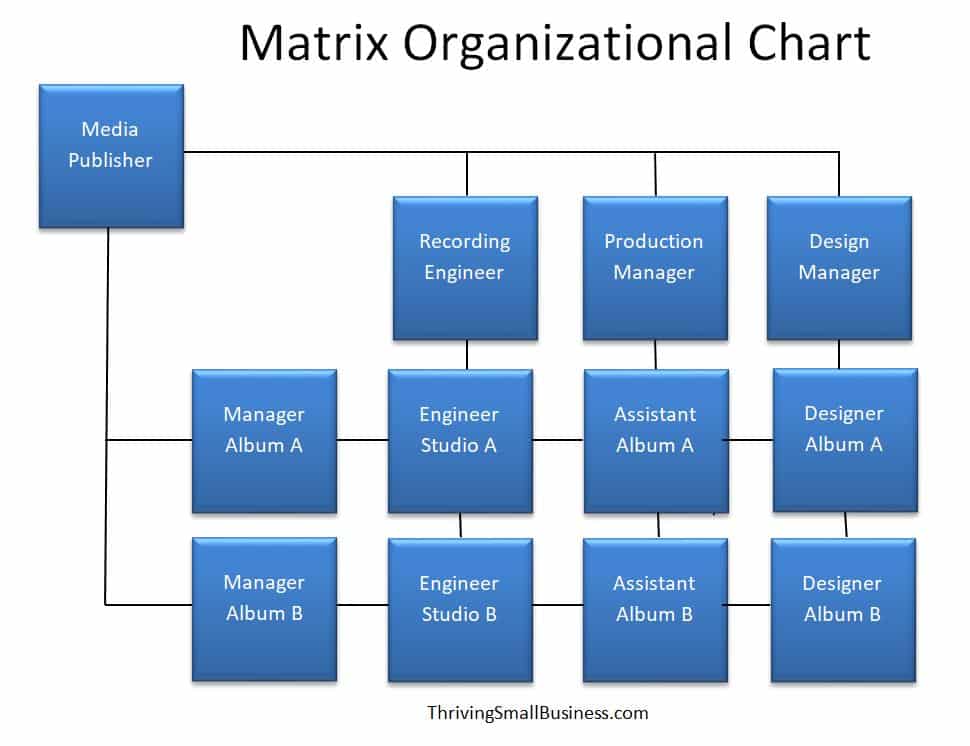
The advantage of a matrix organizational structure is that employees have the responsibility, not only for their department but for organizational projects.
This sharing of responsibilities takes employees out of work silos to share collective knowledge.
A challenge with this type of structure presents itself when employees are given direction from two different managers and they need to prioritize their work responsibilities.
Work to have clear communication practices to avoid these pitfalls.
2. Functional Organizational Structure
Functional organizational structures are the most common.
A structure of this type groups individuals by specific functions performed.
Common departments such as human resources, accounting, and purchasing are organized by separating each of these areas and managing them independently of the others.

For example, managers of different functional areas all report up to one director or vice president who has responsibility for all of the operational areas.
The advantage of this type of structure is that functions are separated by expertise.
This structure presents a challenge when the different functional areas turn into silos that focus only on their area of responsibility and don’t support the function of other departments.
3. Product Organizational Structure
Another common structure is to be organized by a specific product type.
Each product group falls within the reporting structure of an executive and that person oversees everything related to that particular product line.

For example, an executive over Kraft products would be responsible for every product under that label – dressings, meats, sauces, etc.
The advantage of this type of structure is that it organizes products by category but can create completely separate processes from other product lines within the organization.
4. Customer Organizational Structure
Certain industries will organize by customer type.
This is done in an effort to ensure specific customer expectations are met with a customized service approach.
An example of this would be in healthcare.
A patient seen as an outpatient has very different needs than those of patients who spend time in the hospital as inpatients.
A customer-centered structure creates customized care for those patients.
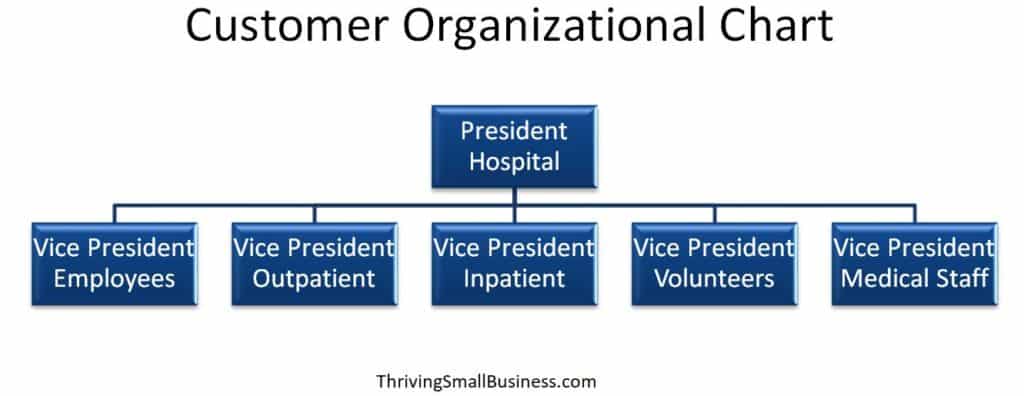
The advantage of this type of structure is that it specializes in the needs of each customer group.
However, the challenge with this approach is that patient care can ignore the needs of different customer types and may lack consistent communication between care specialties.
5. Geographic Organizational Structure
For organizations that cover a span of geographic regions, it sometimes makes sense to organize by region.
This is done to better support logistical demands and differences in geographic customer needs.
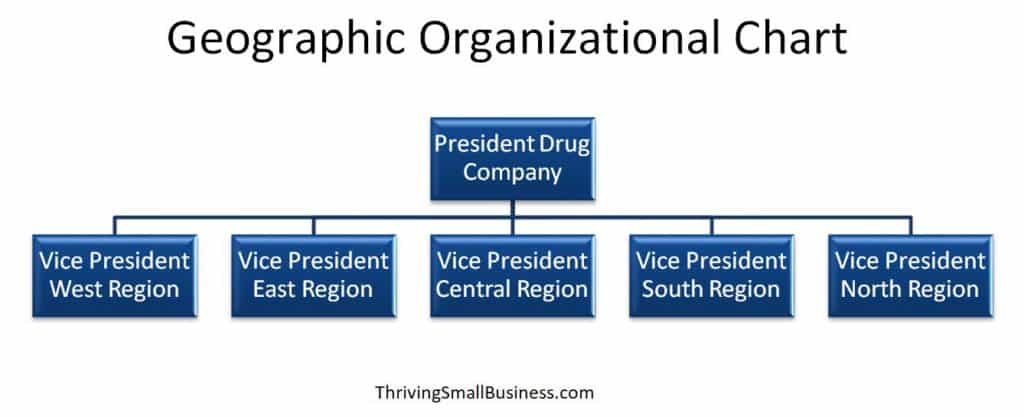
Typically, a structure that is organized by geographical regions reports up to a central oversight person.
You see this type of structure in companies that go beyond a city or state limit and may have customers all across the country or in multiple states.
No Two Businesses Are Alike
Every business has a different mission, vision, and strategy. This diversity in business goals results in the need to invest time and focus on structure.
Invest the time to think through the most appropriate design for your organization’s structure. After all, the structure of your business will serve as building blocks for creating products and services for your customers.
This important management responsibility ensures that employees have a visual of how the organization functions and understand the chain of command.
Operating within a defined structure, with good communication processes and workflows, helps to ensure efficient management of limited business resources – people, time, and money.
Does your organization have an organizational chart?