
Estimated reading time: 5 minutes
We are a few short weeks away from a new year. Hopefully, you have begun your planning for next year!
Strategic plans help identify what an organization is striving to achieve and map out the necessary steps to succeed.
Strategic plans used to go out for ten years, but organizations today typically look 2 to 3 years down the road—some industries just plan year by year.
Developing a strategic plan is a multi-step process, and one step builds on the other.
To begin the process, the organization needs to be passionate about its work and have a clear idea of what it hopes to achieve.
This clarity is what makes the development of the strategy possible.
5 Step Process for Developing a Strategic Plan
Step 1: Write a Vision Statement
A Vision Statement is a statement (typically 2-3 sentences) that gives the reader (and, more importantly, the organization) a mental picture of what the organization hopes to become or achieve.
It is important to understand where an organization is going before it can develop a strategic plan for how to get there.
The value of a vision statement is that it gives leadership and employees a shared goal.
To facilitate a visioning session:
Get the visionaries in a room.
Ask them to close their eyes and describe the mental picture they see when the organization has reached its optimal state.

Document thoughts that describe the picture on a flip chart.
Agree on all that is described.
Take some time to wordsmith or play with the wording until it describes the thoughts accurately.
Example Vision Statement
“ABC Dry Cleaners will be the premier professional laundry
of the metropolitan area by providing unmatched customer
service and cleaning services that exceed the competition.”
Step 2: Write a Mission Statement
A Mission Statement explains why an organization exists and the path it will take to achieve its vision.
Mission statements are typically shorter than vision statements but not always and are organization-specific.
This statement describes what the organization is passionate about and why it exists.
To facilitate the mission statement process:
Have the group review the vision statement and brainstorm a mission statement.
Go around the room, have everyone briefly describe their thoughts (5-7 words), and document their answers on a flip chart.
Once everyone has put their ideas down, look for similarities; usually, a natural statement will flush itself out.
Reword and refine the statement until everyone agrees it reflects the organization’s mission.
Example Mission Statement
“We exist to “help our customers care for
and extend the life of their clothes investment.”
Step 3: Perform a Gap Analysis
A gap analysis is an organization’s process to identify the gaps between its current state and what it hopes to achieve – its vision.
To do a gap analysis, look at where the organization is and compare it to where it hopes to be.
This process typically involves researching data outside the organization and examining data within the organization.
Examples of gaps an organization might look at would be:
- Market Share
- Financials
- Innovation – What is the organization’s approach to innovation
- Internal Process/Systems
- Public Relations
- Customer Satisfaction and Quality of products/service (these are also considered Critical Success Factors).
Example of the organization’s current state:
- Customer Satisfaction scores of 65;
- Profit margin 1%
- 10% of market share
- 10% return on poor-quality cleanings
Step 4: Write SMART Goals
Write SMART goals for 2-3 years out (some organizations choose to go shorter or longer depending on the organization).
Example Organizational Goals:
- By 20xx, ABC Dry Cleaner will have a customer satisfaction score of 85
- By 20xx, ABC Dry Cleaner will have a profit margin of 5%
- By 20xx, ABC Dry Cleaner will have a 25% market share
- By 20xx, ABC Dry Cleaner will have less than 2% return for poor-quality cleanings
Now, this is where the rubber meets the road.
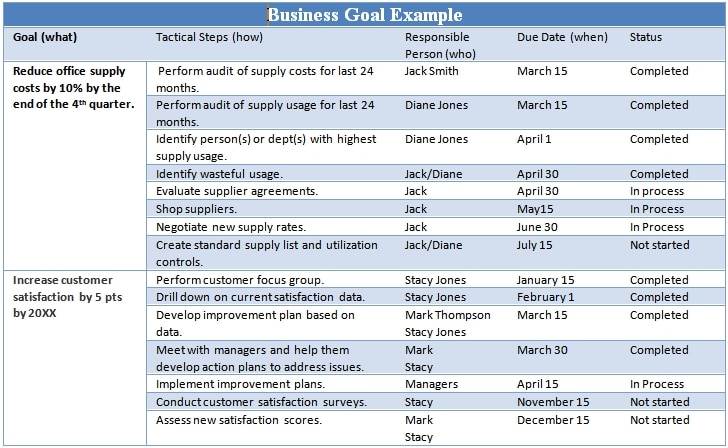
Goals are a wonderful thing to have, but unless they are implemented, and someone is held accountable through a structured performance management process, they are nothing more than words on a piece of paper.
To give goals some teeth, they must be taken down to the department and, ultimately, the employee level.
This means identifying who will get it done.
Example Goal Document
Step 5: Monitor Progress
Goals should be monitored at least every quarter.
This can be as simple as asking the responsible person to give a status update on their goals for the quarter.
It is very important that this is done because all organizations are so busy today that day-to-day responsibilities can sometimes prevent them from completing long-term goals.
The strategic plan and goals should be reviewed and updated once a year to reflect current market conditions and changes and ensure that the goals are focused on the organization’s current state.
Use the goal document to keep track of the status of the goal completion.
Talk about goals at every staff meeting to ensure everyone understands its priority.
Why Organizations Don’t Have A Strategic Plan
Many organizations don’t create a strategic plan because the process intimidates them.
However, any size organization can develop a plan if it solicits the help of a trained facilitator and commits the time and resources to it.
Does your organization have a strategy and plan?
