
Estimated reading time: 5 minutes
Organizations grow and thrive due to implementing a strategic plan that is achieved by organizational goals.
Whether you are new in a manager’s role or a seasoned manager, you recognize the challenge of keeping the day-to-day operations of a business going.
Not to mention the challenge of continually striving to take the organization to the next level.
So, how does a manager balance this conflicting tension?
The quick answer is goals!
The problem is that not every manager knows how to write goals.
However, goals are an essential part of the performance management process and are used to achieve business objectives.
Organizational business goals are a 50,000-foot look at the organization. Looking at the big picture.
However, managing staff every day means that employees need very specific goals.
This gives them a piece of the pie and something to focus on – doing their part in helping the organization move forward.
Employee-specific goals can help do that.
To give you a visual of how a vision implementation process works, let’s look at the following and start at the top of the organization:
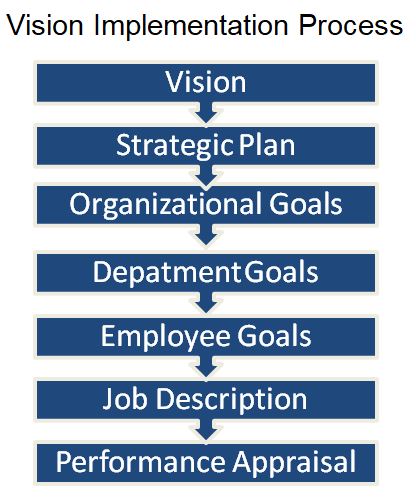
Goals should begin with the vision of the organization. This is looking at the ideal future state that the business is striving for.
The vision drives the strategic plan.
The strategic plan is a document that lays out goals for the organization by year for a multi-year period of time.
Department goals are written to support organizational goals.
Employee goals should support departmental goals.
An employee job description incorporates goals so that an annual performance appraisal serves as a tool to ensure goals are achieved.
Okay, here’s an example of an employee goal that supports the organization’s goals.
Organizational Goal: Improve Employee Satisfaction by 10 pts
Departmental Goal (Human Resources): Improve employee satisfaction by 10 pts
Example of a Human Resources Employee Goal
Employee Name: Betty Smith
Employee Goal: Evaluate Employee Satisfaction, Develop and Implement an Improvement Plan.
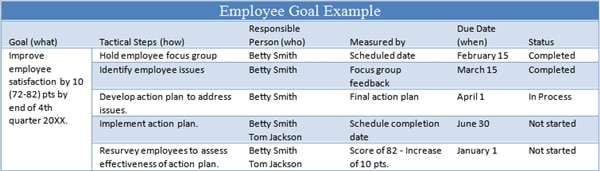
As you can see from this document, Betty Smith’s goals have a direct connection with her department’s goals. Her department, Human Resources, has goals that support the organization’s goals.
6 Tips For Managing Employee Goals
1. Write Annual Goals
Too often, organizations write goals and forget about them.
Organizational goals should be reviewed at least annually to keep them current.
Schedule time in the 4th quarter to update goals and develop employee goals for the following year.
Use the strategic plan for timelines of expected goal completion.
2. Encourage Employee Participation
Goals should be written with the employee to ensure the employee buys in on the goals and has a good understanding of job expectations.
Work with employees to create goals so that their participation can help bridge the resource gap.

Allow employees to voice their objections, fears, or concerns.
Then, help them by ensuring all necessary resources (people, time, and money) are available to support their efforts.
3. Review Goals Quarterly
Years go by quickly. Review goals at least quarterly to ensure that there is consistent progress toward the completion of goals.
For instance, add goal updates to meeting agendas.
This simple step will remind the employee of your commitment to helping them achieve their goals.
4. Goals Are A Dimension On Performance Appraisal
Goals should be included in the written performance appraisal and should carry some weight in the measurement of employee success.
Note: Some goals will have greater importance than others.
For instance, if you have five dimensions on your performance appraisal form – teamwork, job knowledge, communication skills, customer focus, attendance, and punctuality – add a dimension called completion of goals.
This will allow you to rate how well the employee met expectations for goal milestones.
5. Acknowledge A Job Well Done
Employees go to work to do a good job.
However, if you don’t tell them, they are left to wonder.
Make an effort to praise employees and acknowledge when a job is done well – particularly when goals are completed.
6. Reward Employees For Completing Goals
We all go to work and strive to focus on what is most important. Help employees keep this focus by rewarding them for their efforts.
Structure your compensation system to reward employees who complete goals with an annual merit increase.
For instance, create a raise distribution process that awards a higher percentage to employees who complete goals.
Employee engagement goes up when employees recognize that their efforts matter.
Invest in this vital customer group by communicating clear expectations and providing them with the tools/resources they need to do their job.
Reward them when they do a good job, correct them when they don’t, and you’ll have successful and engaged employees!
If you would like a copy of the goal document, click here.