
Estimated reading time: 5 minutes
Anyone who is responsible for managing others will attest to the fact that it can be one of the most challenging aspects of a supervisor’s job.
However when done strategically, and with an end in mind, it can be a positive, and even rewarding, experience for both parties.
Understanding some simple performance management tactics can help!
When I speak to managers, I try to help them understand that managing employees and administering performance appraisals should be a part of how things are done and ingrained into the culture of the organization.
There are some tricks to helping employees perform at high levels, but the most important is the manager’s responsibility for guiding them.
The following three tactics can help a manager ease the pain of managing performance and help affect a positive assessment experience.
3 Tips To Make Managing Employees Easier
1. Set Clear Expectations
Setting employee expectations is one of the first and most crucial steps in managing performance.
Employees need clear direction on what their responsibilities are and a good understanding of what is expected of them.
There are a couple of ways to do this:
The first is to create a detailed job description that is tied to departmental goals – which supports overall strategy and organizational goals.
A job description should have defined responsibilities, very specific job tasks and SMART goals attached to it.

The second is for a manager to spend time with the employee to be sure they receive the appropriate training and have a clear understanding of how to do their job, who to go to with questions, and what to do when they encounter a barrier to getting it done.
The third is for the manager to meet with the employee at about 90 days and reiterate the expectations and clarify any possible confusion in task responsibility – that sometimes comes with actually performing job duties.
One trick I’ve learned is to have the employee verbally repeat expectations that are given to them.
This allows you to hear how they interpreted what you said and gives you an opportunity to clarify any misunderstandings.
2. Confront Any Work-Related Issues
I always say that when you get more than one person in a room, you will have issues.
And dealing with employee issues is an inevitable part of managing people.
Confronting the issues is sometimes a difficult, time-consuming, challenging, and often stressful part of management.
However, performance issues must be identified and addressed quickly to prevent things from worsening.
For instance, if you are a small business and you decide to hire family members, you need to confront issues quickly to ensure the expectations are clear for the family members.
Unresolved issues create confusion and foster an unhealthy work environment. Confront and resolve issues quickly!
3. Take Detailed Notes
Take notes on each employee so you can remember details when it comes time to create the performance appraisal or in the event of an unexpected issue.
Note-taking is simply a documentation of employee performance.
While this can be a tedious and cumbersome task, there are shortcuts to streamline the process. Some things that have worked for me are:
If you use a calendar or day planner, keep a separate page for each employee that you manage.
For example, have a page for Sue Smith, Tom Tucker, Amy Foster, etc. On those pages, you should jot down incidents that happen and keep the following columns:
- Name
- Date
- Time
- Incident
- Persons involved
- Action Taken
The trick is if you observe a positive behavior, tell the employee and jot it down.
If you observe a behavior you want to be changed, mention it to the employee and jot it down.
If you do everything electronically, you can create an Excel spreadsheet and keep a separate page for each employee.
Save it in Google Docs or dropbox to have access anywhere. Try to avoid using personal devices for this kind of information.
Example Note-Taking Log
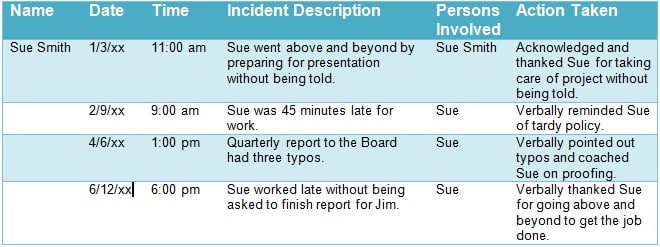
When a manager prepares for the annual performance appraisal, this log provides all the information they need to be objective about how well the employee met expectations.
It also sets the stage to have an honest, factual, and unbiased conversation with the employee that celebrates the successes and corrects behaviors that may have veered off course.
As you can see from the above log, if a manager documents all incidents, both positive and negative, the employee is constantly receiving feedback.
This conversation can provide a learning experience for what the employee behavior boundaries are -while positively reinforcing behaviors that go above and beyond job expectations.
The way you manage employees sets a professional development course for them.
While this may seem to be a lot of extra work, the rewards are great when you see an employee grow and develop.
Not all employees respond to this management method.
However, when you are able to successfully coach employees and witness them grow professionally, it can be one of the most rewarding aspects of managing people.